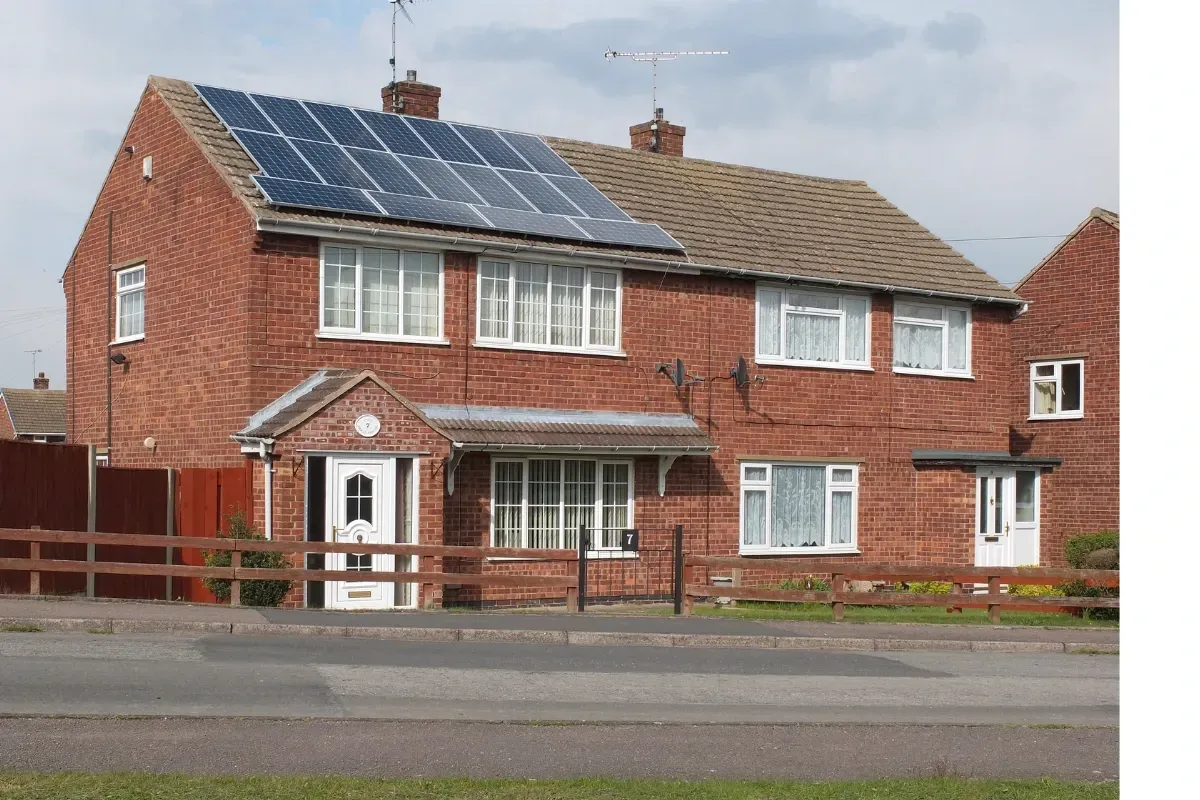
Can Semi-Detached Homes in Manchester Go Solar?
Living in a semi-detached house in Manchester and wondering about solar panels? Perhaps you're worried that sharing a wall complicates things. Here's the truth: semi-detached homes are brilliant for solar energy.
Quick take: Manchester's semi-detached houses work excellently for solar panels. Most have space for a 3-4 kW system (roughly 8-10 panels), costs run £5,000-£7,500, and payback is about 10-12 years. Key factors? Managing shading, checking roof direction, and keeping your neighbour informed. Planning permission isn't usually needed.
Table of Contents
What's Different About Semi-Detached Properties and Solar?
Can Your Semi-Detached Property Handle Solar Panels?
Neighbours, Shared Walls, and Planning: The Real Story
What You'll Pay and What You'll Save with Semi-Detached Solar
Shading & Adjacent Buildings: Your Main Challenge with Semi-Detached Solar
Mistakes to Avoid When Installing Solar on Your Semi-Detached Home
What's Different About Semi-Detached Properties and Solar?
Let's address the elephant in the room: you're attached to another house. Does this matter for solar? Not really, but there are a few things worth knowing.
That shared wall sits between you and your neighbour, and your roofs are side by side. But solar installation work happens entirely on your side of the property line. Any work touching shared structures rarely needs your neighbour's sign-off (although a friendly heads-up never hurts).
What's working in your favour? Semi-detached homes come with generous roof space. You've got a pitched roof with two decent-sized surfaces, often providing plenty of room for a system that'll cover your household's energy needs. Solar panels work on virtually any roof material and structure.
One consideration: being joined to another property means watching for structures next door that might throw shadows. Perhaps they've extended their loft, or there's a chimney on the party wall. These can impact sun exposure, though modern solar tech handles partial shading well.
Bottom line? That shared wall isn't stopping you from going solar. Semi-detached and detached properties work brilliantly for solar thanks to ample roof space and flexibility. If your main roof's not ideal, panels can go on garages or extensions.

Can Your Semi-Detached Property Handle Solar Panels?
Most semi-detached homes across Manchester are ready for solar. Let's break down what actually matters:
Roof Space You've Got Available
Each solar panel takes up roughly 1.6-2.3 m². A typical 3-4 kW home system needs 6-12 panels, translating to about 15-25 m² of your roof.
The good news? A standard three-bedroom semi in Manchester often has around 70 m² of total roof area. That's more than enough for a 3.5 kW setup. Even with less space, today's high-efficiency panels squeeze more power from every square metre.
Which Way Your Roof Faces and Shadow Concerns
Your roof's orientation affects how much energy you'll generate. South-facing roofs are the gold standard, but east or west-facing installations perform brilliantly too, usually producing just 15-20% less compared to south.
East-facing panels work harder in the morning, whilst west-facing ones hit their stride during afternoon and evening hours. North-facing roofs? They're the only ones we'd generally steer clear of. Got a flat roof? No worries - panels can be mounted on angled frames pointing south.
Shading's your biggest enemy here. Shadows from trees, neighbouring buildings, chimneys, or TV aerials will knock down your panels' performance. Ideally, wherever you're placing panels should get unobstructed sunlight most of the day.
If you can't avoid some shading, modern systems use power optimisers or micro-inverters so one shaded panel won't tank your entire system's output.
Your Roof's Construction, Pitch and Condition
Solar panels go on pretty much any roof: pitched slate, concrete tiles, metal, or flat felt roofs. What really counts is whether your roof can handle the weight (each panel's about 20 kg). Most Manchester homes' roof structures manage this load without breaking a sweat.
The angle matters too. A pitch of 30-40° works brilliantly in the UK, catching sunlight effectively and letting rain naturally clean your panels.
Since solar panels keep working for 25+ years, you'll want your roof in decent nick for the long haul. If your roof's getting on a bit (over 10-15 years since the last major work) or showing signs of wear, sort that out before installing solar. If there's any chance you'll need a new roof within the next decade, get that done first.
Neighbours, Shared Walls, and Planning: The Real Story
Planning Permission and Permitted Development
In the UK, most home solar installations fall under "permitted development," which means you don't typically need planning permission. As long as you stick to the basic guidelines (panels don't stick out more than 20 cm from the roof, don't go above the roof's highest point), you're good to go without a formal application.
Your neighbours can't block your solar installation if it meets permitted development rules. You'd only need explicit planning permission in special circumstances (like a listed building or conservation area). For your average semi-detached property in Chorlton or Didsbury, solar panels are usually fine without planning approval.
The Party Wall Situation
Most solar installations stick to your side of the roof and don't physically touch the party wall. A standard panel setup wouldn't normally trigger the Party Wall Act. That said, if your installation involves work on a shared wall or you're mounting kit to a shared chimney, you might need to give your neighbour formal notice.
Some semi-detached homeowners in Manchester coordinate their installations with their attached neighbour. This can work brilliantly if both parties are up for it - you could potentially share scaffolding costs and get the job done together.
Even if your neighbour's not interested, keeping them in the picture is just good practice. Solar panels use anti-reflective glass and actually produce less glare than a typical window. As long as your panels don't overhang into your neighbour's property, you're well within your rights.
What You'll Pay and What You'll Save with Semi-Detached Solar
Let's talk numbers.
What It Costs Upfront
In Manchester, a standard 3.5 kW home solar system (around 10 panels) runs roughly £6,000-£7,500 for professional installation as of 2026. This assumes a straightforward job on a pitched roof with reasonable access.
Prices vary by system size. Adding a battery? That's another £5,000-£8,000. Solar installations are zero-rated for VAT in the UK.
Your Savings and When You'll Break Even
Solar panels cut your electricity bills from day one. Recent analysis suggests a typical solar setup in England pays for itself in roughly 10-12 years, assuming you're using a decent chunk of the energy you generate.
A 3-4 kW system in Manchester might generate around 3,000-3,500 kWh annually. Using 70% directly and selling 30% back to the grid, you could save £600-£700 yearly on electricity bills, plus another £50-£100 from export payments through the Smart Export Guarantee.
What Affects These Numbers?
Several factors can speed up or slow down your payback:
How much you use directly (working from home, charging an EV during daylight) makes solar more valuable
Location within Manchester: Greater Manchester gets decent sunlight, though southern parts of the UK might generate 10-15% more
Rising energy prices: if electricity costs keep climbing, solar pays back faster
Installation complexity: extra work like upgrading your consumer unit can bump up the initial cost
Even accounting for these variables, going solar on a semi-detached Manchester home is typically a solid long-term investment with healthy annual returns.

Shading & Adjacent Buildings: Your Main Challenge with Semi-Detached Solar
When it comes to solar performance, shading's your number one enemy. Solar PV cells are incredibly sensitive to shadows. Research shows that if just one cell on a panel gets shaded, that panel's output can plummet by 50-80%. When one panel in a series string gets heavily shaded, it can drag the whole string's generation down close to zero.
For semi-detached houses across areas like Ancoats or the Northern Quarter, typical shade culprits include a neighbour's two-storey extension, mature trees, shared chimneys, or the neighbouring property itself if the roofs sit at different heights.
Semi-detached properties often have one roof face that catches more sun than the other. Focus your panels on the sunniest sections, even if that means going with an east or west orientation rather than perfect south. If the source of shading is something on your property (like a tree), consider trimming it back.
When you can't eliminate shading completely, micro-inverters or power optimisers let each panel work independently. With old-school string inverters, shade on one panel could cripple your whole array's output, but with panel-level optimisation, the shaded panel gets bypassed whilst the rest keep performing.
Most experienced installers will recommend micro-inverters or optimisers if your Manchester property has partial shading patterns throughout the day.
Mistakes to Avoid When Installing Solar on Your Semi-Detached Home
Skipping the Roof Assessment
Don't jump straight into installation without checking whether your roof's actually ready. If you've got damaged tiles or your roof's past its best, you might end up pulling panels off in a few years to fix underlying issues. Get your roof checked and confirmed structurally sound before anything goes up. Also, think strategically about panel placement on your best roof sections, not just wherever's easiest to access.
Ignoring Local Requirements
Do your homework on what regulations apply to your specific property. This includes notifying your Distribution Network Operator (DNO) and making sure everything meets building regulations. Working with professionals from Solar Panels Manchester means these boxes get ticked properly.
Forgetting About Maintenance and Warranties
Know exactly what warranties you're getting: panels usually come with 25-year performance warranties, inverters typically get 5-10 years. Register any manufacturer warranties straight away. The good news? Solar maintenance is pretty minimal. Just keep an eye on your system's performance through the inverter app.
Final Thoughts on Solar for Semi-Detached Houses
Solar panels make brilliant sense for semi-detached homeowners in Manchester. Being attached to a neighbour doesn't create barriers - it just means a bit of extra planning and maybe a friendly conversation.
Semi-detached houses make up a massive chunk of Manchester's housing stock, representing a huge opportunity for expanding residential solar across the city. With a suitable roof, manageable shading, and your neighbour in the loop, there's no reason your semi can't enjoy the same energy savings and environmental benefits as any detached property.
There's something quite powerful about the community aspect too. When one half of a semi-detached pair goes solar, it often sparks interest next door. By installing solar panels, you might inspire others across Manchester to join the solar swarm.
Solar on a semi-detached house in Manchester isn't just feasible - it's a smart, future-proof upgrade that adds value to your property. The benefits are real: decades of electricity savings, contributing to Manchester's greener future, and taking control of your own energy supply.
Want to explore solar options for your Manchester home? Get in touch to discuss how solar panels can work for your semi-detached property. The sun's here to power-the-house for all of us.
Solar for Semi-Detached Houses FAQs
Do I need planning permission to install solar panels on a semi-detached house?
In most situations, no formal planning permission is needed. Solar panels fall under permitted development provided certain conditions are met. Your neighbours generally can't legally object to your installation. The main exceptions are if your Manchester home sits in a conservation area or it's a listed building.
How many solar panels can I fit on a semi-detached house?
You can typically fit about 8 panels on your main roof surface. If you've got extra roof areas (like a rear extension or garage), you could fit more. A standard 3-bed semi usually has room for a 3-4 kW system (6-12 panels). The right number depends on your energy usage and what you're willing to invest.
How much do solar panels cost in Manchester, and what is the payback time?
A typical 3.5 kW system runs roughly £5,000-£6,500 in Manchester. This covers panels, inverter, installation, and there's 0% VAT. Payback time sits around 10-12 years. Since panels often last 25+ years, you'd get over a decade of essentially free energy after you break even.
Does my roof need to face south for solar to be worthwhile?
Not at all. South-facing is ideal, but east or west-facing roofs work perfectly well, typically producing only about 15-20% less energy. North-facing roofs are the only ones we'd generally recommend against. Real-world data shows east and west-facing solar panels still generate roughly 80-85% compared to an equivalent south-facing system.
Will installing solar panels damage my roof?
When installed by qualified professionals, solar panels won't damage your roof. Roof damage from solar panel installation is extremely rare. Installers use specialist mounting brackets with proper waterproofing to prevent any leaks. Reputable installers provide a workmanship warranty (typically 5-10 years) that covers roof integrity. Hire an experienced, certified installer like the team at Solar Panels Manchester.
Should I replace my roof before installing solar panels?
If your roof's over 15-20 years old or you've noticed leaks or missing tiles, sort the roof out first. You don't want to be removing panels in 5 years to fix a failing roof. If your roof's relatively young (under 10 years old) and in good condition, there's no need to replace it before going solar.
What if part of my roof is shaded?
You can still go solar, but you'll need to handle the shading carefully. Your installer can position panels to avoid the worst shaded spots and use micro-inverters or power optimisers so a shaded panel's reduced output won't affect the others. If the shade's coming from a tree on your property, you can trim it. Consider adding battery storage to make the most of solar energy generated during peak sun hours.
